The Leadership Execution Gap: Why Good Intentions Don't Prod
Published Article - Jerry Thomas
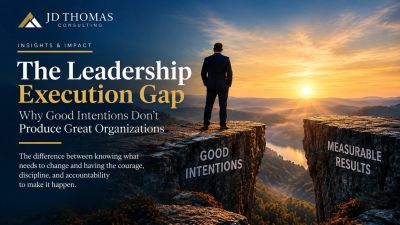
The difference between knowing what needs to change and having the courage, discipline, and accountability to make it happen.
When Good Intentions Are Not Enough
There is a significant difference between understanding what an organization needs to accomplish and having the leadership discipline necessary to make it happen. Throughout my career, I have worked with organizations facing a wide range of challenges, including declining performance, leadership transitions, organizational restructuring, employee engagement, operational inefficiencies, and the complexities associated with growth. While the circumstances were often different, one characteristic appeared with surprising consistency: leadership frequently understood the problems confronting the organization, yet struggled to implement the changes necessary to resolve them.
In many of these situations, the leadership team was neither inexperienced nor indifferent. These were capable professionals who genuinely cared about their organizations, employees, and customers. They could identify operational weaknesses, recognize opportunities for improvement, and articulate reasonable strategies for moving forward. Meetings were conducted, recommendations were discussed, and plans were developed with considerable enthusiasm. Yet despite these efforts, meaningful improvement remained elusive. Months would pass, sometimes years, and the organization would find itself confronting many of the same challenges.
This disconnect between recognizing what needs to happen and consistently delivering meaningful results is what I refer to as the Leadership Execution Gap. It is the distance between an organization's stated intentions and its demonstrated ability to translate those intentions into sustainable performance. Although this gap may initially appear to be an operational challenge, I believe it is fundamentally a leadership issue, one that influences organizational culture, employee confidence, customer experience, and ultimately, long-term success.
Closing this gap requires more than developing another strategic plan, conducting another leadership retreat, or announcing another organizational initiative. It requires a willingness to examine how leadership decisions are made, how responsibilities are assigned, how accountability is established, and whether the organization's daily behaviors genuinely support its stated priorities.
The Difference Between Knowing and Doing
Most organizations do not suffer from a shortage of ideas. Leadership teams regularly identify opportunities to improve customer service, strengthen employee performance, streamline processes, develop future leaders, and enhance communication across departments. These discussions are often productive, and the recommendations that emerge may be entirely appropriate. The difficulty arises when those recommendations must compete with the demands of daily operations and the established habits of the organization.
An initiative that initially receives considerable attention can quickly lose momentum when urgent operational matters begin consuming leadership's time. Decisions that appeared straightforward during a planning session become more complicated when resources must be allocated, responsibilities reassigned, or established practices challenged. Difficult conversations are postponed, competing priorities emerge, and employees begin to recognize that the initiative receiving so much attention several weeks earlier is no longer a visible leadership priority. Eventually, the organization returns to familiar routines, often without formally acknowledging that the intended improvements were never achieved.
This pattern can become particularly damaging when it repeats itself. Employees begin to distinguish between initiatives that leadership announces and those it is genuinely committed to implementing. Over time, enthusiasm gives way to skepticism, and even worthwhile organizational improvements encounter resistance because employees have experienced too many previous efforts that failed to produce meaningful change.
One of the most important distinctions leaders must understand is the difference between organizational activity and organizational progress. An executive calendar filled with meetings may create the appearance of engagement, but it does not necessarily demonstrate effectiveness. Similarly, detailed strategic plans, extensive performance reports, and frequent organizational communications may provide valuable information without producing improved results. The real measure of leadership effectiveness is whether these activities contribute to measurable progress toward meaningful organizational objectives.
Effective leadership requires the discipline to move beyond identifying opportunities and establishing priorities. It requires making decisions, assigning clear responsibility, providing appropriate resources, evaluating progress, and maintaining organizational focus long enough for improvement to become sustainable. Without that discipline, even the strongest ideas remain little more than good intentions.
When Leadership Becomes the Bottleneck
When organizations experience performance challenges, the natural response is often to examine employees, departments, operating systems, or external circumstances. These areas deserve attention, but they should not become substitutes for examining leadership effectiveness. In some organizations, the greatest obstacle to improvement is not a lack of employee capability or operational resources, but the behaviors and decision-making practices of the leadership team itself.
This can be a difficult possibility for leaders to consider because most are genuinely committed to organizational success. They work long hours, accept significant responsibilities, and often believe they are doing everything reasonably possible to address the challenges confronting their organizations. However, dedication and effort do not necessarily guarantee effective leadership. A leader can be exceptionally hardworking while unintentionally creating obstacles that limit the performance of others.
For example, leaders who consistently postpone decisions while seeking additional information may believe they are demonstrating prudence, but their hesitation can prevent employees from moving forward. Executives who avoid difficult conversations in an effort to preserve relationships may unintentionally allow performance problems to become accepted organizational behavior. Leaders who insist on personally approving routine decisions may believe they are maintaining quality and consistency, while actually discouraging initiative and creating unnecessary delays throughout the organization.
These behaviors often develop gradually and may not be immediately recognized as leadership problems. Over time, however, they influence how employees approach their responsibilities. Individuals become reluctant to make decisions without approval, departments hesitate to collaborate across organizational boundaries, and employees learn that maintaining familiar practices may be safer than recommending meaningful improvements. What initially appears to be a performance problem among employees may actually reflect the operating environment created by leadership.
This is why leadership effectiveness requires a willingness to engage in honest self-examination. Leaders must periodically consider whether their own habits, assumptions, communication practices, and decision-making processes are helping the organization advance or unintentionally holding it back. Such reflection requires humility, particularly among experienced leaders who have achieved considerable success using approaches that may no longer be appropriate for the organization's current circumstances.
Organizations cannot reasonably expect employees to embrace continuous improvement while their leaders remain unwilling to challenge their own behaviors. Sustainable organizational change begins when leadership accepts that its responsibilities extend beyond identifying what others need to do differently and include determining what leadership itself must change.
The Hidden Organizational Cost of Inaction
The consequences of poor execution are often evaluated primarily through financial performance. Declining profitability, increasing operating expenses, reduced productivity, and missed revenue opportunities are measurable indicators that something may not be working as intended. However, the true cost of organizational inaction frequently extends beyond what can be identified in financial statements or operating reports.
Consider the effect on employees when leadership repeatedly announces initiatives that fail to produce meaningful results. Initially, employees may welcome the proposed changes, particularly when those changes address longstanding concerns about communication, working conditions, operational systems, or organizational direction. Their willingness to participate reflects a belief that leadership recognizes the challenges and intends to resolve them. When promised improvements do not materialize, however, employees begin questioning whether their involvement and commitment will make any difference.
As this pattern continues, organizational trust can gradually deteriorate. Employees may become less willing to offer suggestions, participate in improvement initiatives, or assume responsibilities beyond their immediate job requirements. Some individuals become frustrated enough to seek opportunities elsewhere, while others remain with the organization but reduce their level of engagement. In either case, the organization loses access to some of the initiative, creativity, and discretionary effort that contribute to stronger performance.
The impact can also extend to customer relationships. Employees who operate within an environment characterized by inconsistent direction, unresolved problems, or unclear accountability may struggle to provide the level of service the organization promises. Customers experience the consequences of internal leadership weaknesses even when they have little visibility into the underlying causes. A recurring service problem, delayed response, or inconsistent customer experience may appear to be an employee performance issue when the deeper problem involves organizational processes or leadership decisions that have never been adequately addressed.
What makes these consequences particularly concerning is that they often develop gradually. An organization may continue meeting basic financial objectives while its culture becomes less collaborative, its employees become less engaged, and its ability to adapt begins to weaken. By the time these problems become clearly visible in operating results, leadership may already be confronting challenges that require substantial effort to reverse.
The cost of inaction, therefore, should not be measured solely by the initiatives that fail or the opportunities that are missed. It must also include the confidence, commitment, and organizational credibility that can be lost when leadership repeatedly fails to translate its intentions into meaningful action.
Accountability Begins with Leadership
Accountability is frequently discussed as an essential element of organizational performance, yet it is often treated primarily as a mechanism for evaluating employees or addressing underperformance. While establishing expectations and evaluating results are important, effective accountability begins with leadership's responsibility to create an environment in which employees understand what success requires and have a reasonable opportunity to achieve it.
Before holding employees accountable for results, leaders should ensure that expectations are clearly communicated, responsibilities are appropriately defined, and individuals have the resources and authority necessary to fulfill their assignments. Employees cannot consistently deliver against standards they do not understand, nor can they reasonably be expected to overcome organizational barriers that leadership has failed to address. Accountability without clarity or support can become a source of frustration rather than a mechanism for improving performance.
Equally important is the consistency with which accountability is demonstrated throughout the organization. Employees observe whether executives honor their commitments, acknowledge mistakes, respond constructively to performance concerns, and apply organizational standards fairly. When leaders expect discipline and follow-through from employees but routinely excuse similar shortcomings within the leadership team, the organization's credibility begins to weaken.
I have long believed that accountability is most effective when it is understood as a shared commitment to achieving agreed-upon outcomes rather than simply assigning blame when something goes wrong. This approach encourages honest discussions about performance, identifies obstacles that may be preventing success, and creates opportunities for leaders and employees to work collaboratively toward improvement. It also recognizes that performance problems can result from several different causes, including insufficient training, unclear expectations, inadequate resources, poor communication, or a genuine unwillingness to meet established standards.
These circumstances require different leadership responses. An employee who lacks the necessary skills may benefit from additional training or coaching, while an employee whose responsibilities are poorly defined may need greater clarity and direction. An individual who consistently fails to meet reasonable expectations despite appropriate support may require a more direct performance intervention. Effective leaders distinguish among these situations rather than applying the same response to every performance challenge.
When accountability is established thoughtfully and demonstrated consistently, it becomes an important contributor to organizational confidence. Employees understand what is expected, recognize how their work contributes to broader objectives, and trust that performance standards apply throughout the organization. This environment supports stronger execution because responsibility is clearly understood and progress can be evaluated without relying on assumptions or informal expectations.
Creating an Organizational Culture That Executes
Closing the Leadership Execution Gap requires more than individual determination. It requires establishing organizational practices that consistently connect leadership priorities with daily decisions, employee responsibilities, and measurable results. While the specific approach will vary depending on an organization's size, structure, and circumstances, several principles are particularly important.
The first is recognizing that organizational capacity is limited. Leadership teams frequently attempt to address too many priorities simultaneously, believing that launching additional initiatives demonstrates responsiveness and ambition. In practice, an excessive number of competing priorities can dilute attention, overwhelm employees, and make it difficult to determine which objectives genuinely matter. Effective leaders understand that meaningful improvement often requires making deliberate choices about what the organization will pursue and, just as importantly, what it will postpone or discontinue.
Once priorities are established, responsibility must be clearly assigned. Every significant initiative should have an individual who understands the desired outcome, accepts responsibility for coordinating implementation, and possesses sufficient authority to move the effort forward. Without clear ownership, even well-designed initiatives can become trapped between departments or delayed by uncertainty about who is responsible for making decisions.
Communication is equally important, particularly when an initiative requires employees to change established behaviors or adopt new processes. Announcing a decision is not the same as creating organizational understanding. Employees need to know why the change is necessary, how it relates to broader organizational objectives, what will be expected of them, and how success will be evaluated. They also need opportunities to ask questions and identify practical challenges that leadership may not have fully considered.
Resistance to change should not automatically be interpreted as employee unwillingness. In many cases, concerns reflect legitimate uncertainty about resources, responsibilities, workload, or the potential consequences of implementation. Leaders who listen carefully can often identify obstacles that would otherwise emerge later as execution failures. This does not mean every concern should prevent action, but it does mean that effective execution benefits from understanding the perspectives of those responsible for carrying out the work.
Organizations must also establish a consistent process for evaluating progress. This does not require creating elaborate reporting systems or increasing administrative burdens. Instead, leaders should identify a manageable set of meaningful performance indicators and review them regularly enough to determine whether the intended improvements are occurring. When results fall short, the objective should be to understand why and make appropriate adjustments before small problems become larger organizational challenges.
Perhaps most importantly, execution must become an expected leadership behavior rather than an occasional organizational initiative. Leaders should demonstrate that commitments matter, decisions require follow-through, and performance is evaluated based on results rather than explanations alone. Over time, these practices influence organizational culture by establishing a consistent connection between what leadership communicates and what the organization actually does.
Organizations that execute effectively are not necessarily those that make perfect decisions. They are organizations that develop the discipline to make thoughtful decisions, learn from experience, respond to changing circumstances, and maintain accountability for meaningful outcomes.
The Courage to Lead Differently
One of the more difficult realities of leadership is recognizing that the approaches responsible for past success may not be sufficient to address future challenges. As organizations grow, markets evolve, technologies change, and employee expectations shift, leadership practices must evolve as well. The challenge is that successful leaders often become comfortable with the very habits and methods that helped them achieve their earlier accomplishments.
A business owner who successfully managed every important decision during the organization's early development may eventually discover that the same level of personal involvement is limiting growth. A department leader who built a reputation as an exceptional problem solver may need to learn how to develop employees who can solve problems independently. An executive team that relied on informal communication during a period of relative stability may need more structured processes as organizational complexity increases.
These transitions require leaders to reconsider how they define their own effectiveness. Leadership is not simply about possessing the knowledge or experience necessary to solve problems. It increasingly involves creating an environment in which others can exercise sound judgment, assume appropriate responsibility, and contribute to organizational success without unnecessary dependence on senior leadership.
This is one reason I believe leadership development should be viewed as a continuing organizational investment rather than an occasional response to a crisis. Organizations regularly invest in technology, facilities, marketing, and operational improvements, yet sometimes devote comparatively little attention to developing the leadership capabilities necessary to maximize those investments. New technology may improve access to information, but it cannot compensate for poor communication or indecisive leadership. Organizational restructuring may clarify reporting relationships, but it will not automatically resolve longstanding issues involving trust, accountability, or collaboration.
Leadership coaching, professional development, mentoring, and organizational assessments can provide valuable opportunities for individuals and teams to examine their effectiveness and strengthen important capabilities. However, the value of these investments depends on whether leaders are willing to apply what they learn. Attending a leadership program or participating in a strategic planning session does not, by itself, produce meaningful organizational improvement. The real benefit emerges when new insights influence daily decisions, communication practices, and leadership behaviors.
The courage to lead differently often begins with acknowledging that something needs to change, even when that change involves our own established practices. For experienced leaders, this may be one of the most demanding aspects of professional growth, but it is also among the most important.
A Leadership Perspective: Lessons From Experience
Over more than three decades of working with organizations, I have come to appreciate that sustainable performance improvement rarely results from a single dramatic decision or an extraordinary strategic initiative. More often, meaningful progress develops through a series of deliberate leadership choices that gradually strengthen the organization's ability to perform.
These choices may involve addressing a difficult personnel issue that has been avoided for too long, clarifying responsibilities that have created confusion between departments, or investing time in developing an employee whose potential has not been fully realized. They may require challenging an established operating practice, reconsidering how performance is measured, or acknowledging that a previously successful strategy is no longer producing the desired results.
Individually, these decisions may appear relatively modest. Collectively, however, they establish the expectations, behaviors, and operating discipline that shape organizational performance. When leaders consistently demonstrate sound judgment, communicate clearly, accept responsibility, and follow through on commitments, they create an environment in which employees are more likely to do the same.
I have also observed that organizations often experience their most meaningful improvements when leadership becomes willing to challenge assumptions that have gone unquestioned for years. Problems previously accepted as unavoidable begin to receive renewed attention. Longstanding practices are evaluated against current organizational needs rather than historical preferences. Leadership teams begin distinguishing between explanations for poor performance and the actions necessary to improve it.
This shift in perspective can be transformative because it moves the organization away from simply managing recurring problems and toward addressing their underlying causes. It also reinforces the understanding that leadership effectiveness is not measured exclusively by personal effort or professional experience, but by the organization's capacity to achieve results through the collective contributions of its people.
There is an important difference between inspiring an organization and equipping it to succeed. A compelling vision can create enthusiasm and establish direction, but without consistent execution, that enthusiasm can eventually become frustration. Ambitious performance objectives can encourage improvement, but without clear accountability and appropriate support, they may remain little more than aspirations. Promises of organizational change can generate optimism, but without sustained leadership commitment, they can become reminders of opportunities that were never fully pursued.
For me, the true measure of leadership is not simply what we intend to accomplish or how effectively we communicate those intentions. It is what our organizations become capable of accomplishing because of the decisions we make, the people we develop, and the expectations we consistently demonstrate.
Closing the Gap Starts with Leadership
As organizations begin preparing for the coming year, leadership teams will naturally turn their attention toward budgets, strategic priorities, operating plans, and anticipated opportunities. These activities are necessary and valuable, particularly in an environment where organizations must continually respond to changing economic conditions, customer expectations, and competitive pressures.
However, before adding another initiative to the organizational agenda, I would encourage leaders to spend some time examining the commitments and challenges that remain unresolved from the current year. Consider the decisions that have been repeatedly postponed, the performance concerns that continue to appear in leadership discussions, and the organizational improvements that were announced with enthusiasm but never fully implemented.
More importantly, consider whether the organization's leadership practices have contributed to these outcomes. Have priorities been communicated clearly and consistently? Have individuals been given sufficient authority and support to fulfill their responsibilities? Has leadership demonstrated the accountability it expects from employees? And have difficult decisions been addressed in a timely manner, or allowed to remain unresolved because taking action would create discomfort?
These questions may reveal challenges that cannot be solved through additional planning alone. They may require changes in leadership behavior, more effective communication, stronger accountability, or a renewed investment in developing the organization's people. In some cases, they may also require an objective outside perspective to help leadership identify patterns that have become difficult to recognize from within the organization.
Throughout our recent What If? leadership series, we encouraged leaders to consider how asking different questions might reveal new possibilities for themselves and their organizations. The premise was straightforward: better questions can challenge assumptions, encourage reflection, and create opportunities for meaningful change.
But the value of a better question ultimately depends on what happens after it is asked. If the resulting insight does not influence decisions, behaviors, or organizational priorities, the opportunity for improvement may never be realized. Leadership must therefore move beyond thoughtful reflection and accept responsibility for translating what has been learned into meaningful action.
Great organizations are not built through good intentions alone. They are developed through leadership teams that establish clear expectations, cultivate capable people, make thoughtful decisions, embrace accountability, and maintain the discipline necessary to follow through. Their success is not simply the product of knowing what should be done, but of consistently doing what is necessary to achieve the results they seek.
Better questions create possibilities. Leadership execution turns those possibilities into results.
As we look toward the year ahead, perhaps the most important question for every leader is not what additional initiatives should be introduced, but what commitments we are finally prepared to act upon. Because the distance between organizational potential and organizational performance is often determined by the willingness of leadership to close the execution gap.
Ready to Turn Leadership Intentions into Organizational Results?
At JD Thomas Consulting, we work with business owners, executives, leadership teams, and nonprofit organizations to strengthen leadership effectiveness, improve organizational performance, and navigate the challenges of growth and change. Through leadership development, executive coaching, organizational consulting, and strategic facilitation, we help leaders identify the obstacles limiting performance and develop practical approaches for achieving meaningful, sustainable improvement.
If your organization continues to confront familiar challenges despite thoughtful planning and good intentions, it may be time to examine the leadership practices influencing those outcomes. An objective conversation can often reveal opportunities that are difficult to recognize while managing the demands of daily operations.
Contact JD Thomas Consulting to begin a conversation about strengthening your leadership team, improving organizational execution, and translating your strategic priorities into measurable results.
JD Thomas Consulting
Stronger Leadership. Better Performance. Lasting Impact.
Because better questions create better leaders. Better leaders build better organizations.
Jerry Thomas
Principal | JD Thomas Consulting